
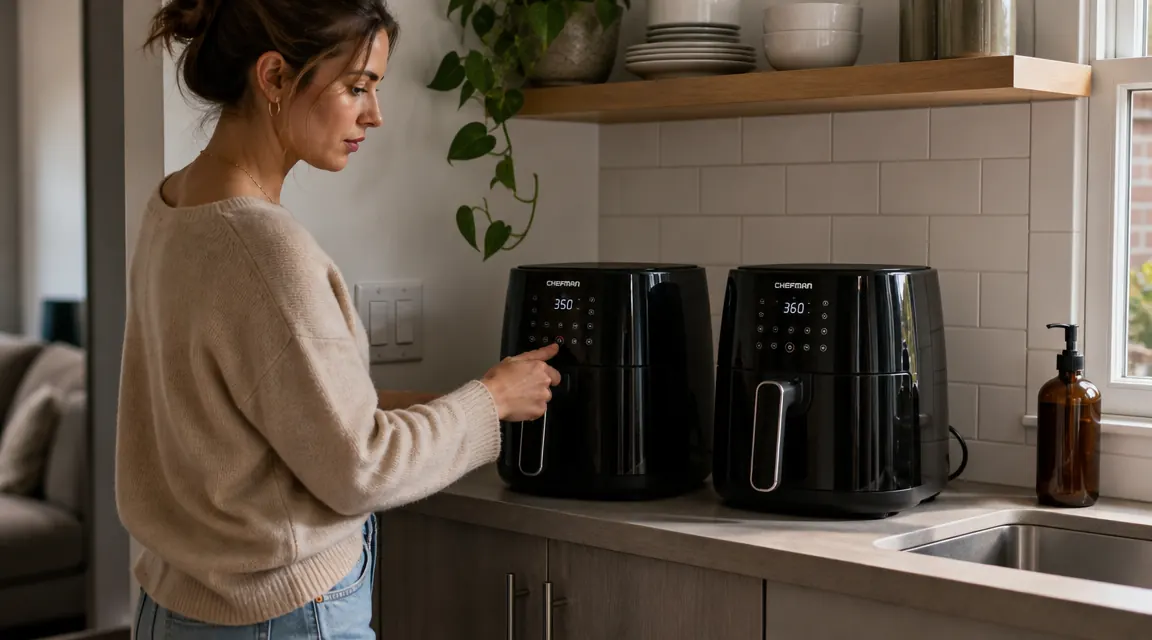
I had both of these on my counter at the same time for three weeks. Not because I love clutter, but because someone had to measure them, cook the same meals in each, and figure out which one actually deserves the 11 inches of counter depth it takes up in a small kitchen. If you're choosing between the Ninja AF101 and the Cosori 4-quart, here is the short answer: the Ninja wins, and it isn't particularly close on the metrics that matter most to small-kitchen cooks.
That said, the Cosori is not a bad machine. It's a capable air fryer with a feature set that looks better on paper than the Ninja's. Understanding why the Ninja still comes out ahead tells you a lot about how to think about compact appliance purchases in general. So let's go through it properly.
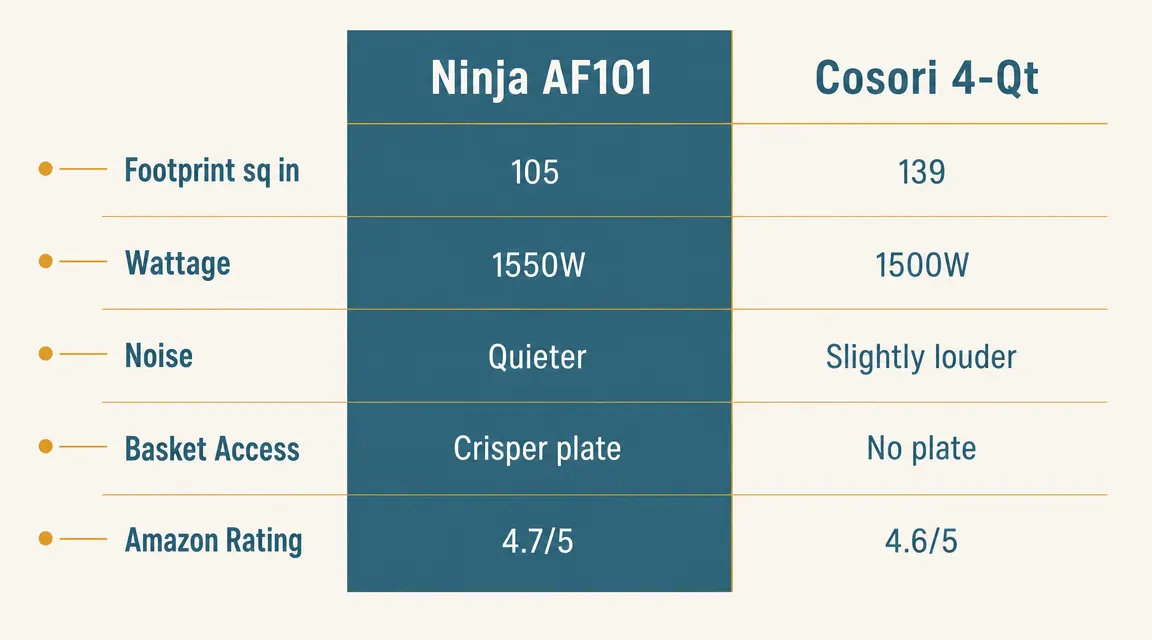
| Ninja AF101 | Cosori Air Fryer | |
|---|---|---|
| Price | Check today's price | Check Cosori listing |
| Capacity | 4 quarts | 4 quarts |
| Footprint | 11.1 x 9.5 in base | 11.8 x 11.8 in base |
| Height | 12.6 in | 12.4 in |
| Wattage | 1550W | 1500W |
| Cooking Functions | 4 (Air Fry, Roast, Reheat, Dehydrate) | 9 presets |
| Temperature Range | 105F to 400F | 170F to 400F |
| Basket Design | Crisper plate + square basket | Square basket, no crisper plate standard |
| Noise Level | Quieter fan cycle | Slightly louder |
| Amazon Rating | 4.7 / 5 (90,000+ reviews) | 4.6 / 5 |
| Warranty | 1 year | 1 year |
Where the Ninja AF101 Wins
The footprint difference is the first thing you notice when both machines are on the counter together. The Cosori's square base measures 11.8 by 11.8 inches. The Ninja's rectangular base comes in at 11.1 by 9.5 inches. That's roughly 139 square inches for the Cosori versus about 105 square inches for the Ninja. In a kitchen with 30 inches of usable counter, that gap is the difference between fitting the fryer plus a cutting board or fitting the fryer and nothing else. Square-inch math matters when you live in a studio.
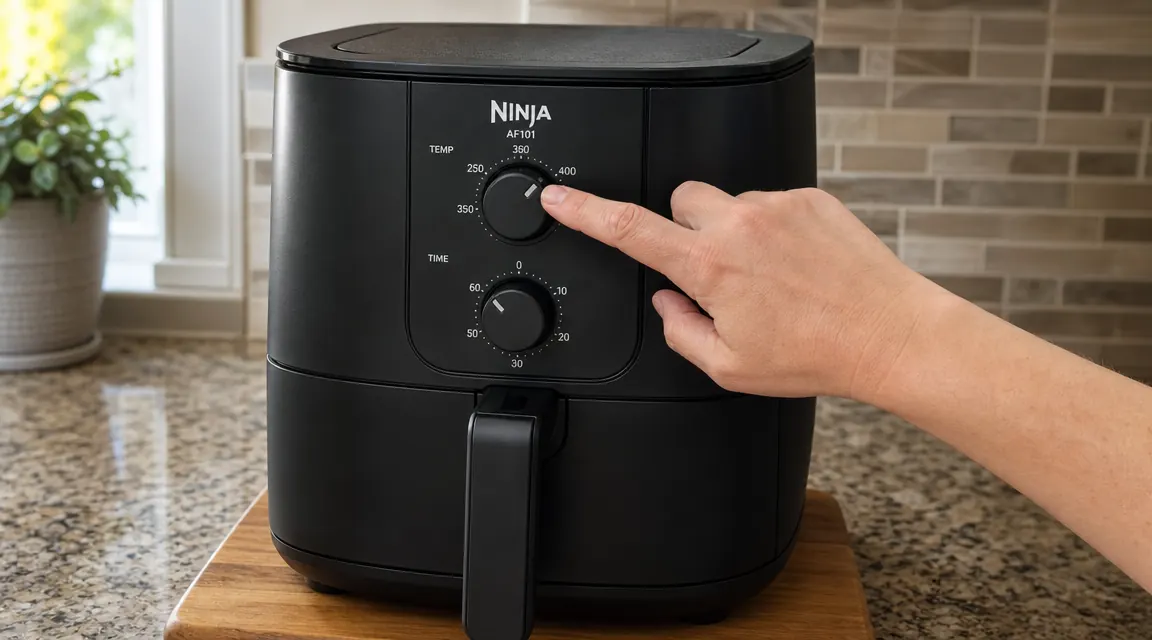
The Ninja also runs a lower dehydrate temperature, bottoming out at 105 degrees Fahrenheit versus the Cosori's 170-degree floor. If you ever want to make jerky, dry herbs from a windowsill garden, or dehydrate fruit without cooking it, that range matters. The Cosori's low end is effectively just 'warm,' not 'dehydrate.' On the basket design, the Ninja ships with a crisper plate that sits raised inside the basket, letting air circulate under food. That plate is the reason chicken thighs come out with an actual crust rather than a soggy bottom. The Cosori basket works, but the cooking surface contact is higher without a dedicated crisper insert, and you can tell in the texture of skin-on proteins.
Noise is harder to quantify without a decibel meter, but after running both machines for three weeks at similar temperatures and durations, the Ninja's fan is noticeably quieter during the cooking cycle. In a studio where the kitchen is 8 feet from the couch, that matters at 11pm when you're reheating leftovers. The Cosori sounds like it's working harder even when it isn't.
Where the Cosori Wins
The Cosori has nine cooking presets versus the Ninja's four. If you're the kind of cook who wants a dedicated button for shrimp, steak, vegetables, frozen foods, bacon, and chicken separately, the Cosori delivers that. The display is also a touchscreen LCD panel, which looks more modern and is easier to read than the Ninja's dial-and-button interface. For someone who wants preset-driven cooking without thinking about time and temperature manually, the Cosori is more accommodating.
The Cosori basket is also slightly easier to clean in one specific way: the entire basket assembly is dishwasher safe without the step of separating the crisper plate. The Ninja basket is also dishwasher safe, but you need to pull out the crisper plate to clean both pieces. It is a 30-second step, but it's worth noting for anyone who treats the dishwasher as sacred. If preset cooking and a touchscreen are your priorities, the Cosori makes a real case. For small-kitchen cooks focused on footprint and consistent cooking results, it doesn't close the gap.
If counter space is your constraint, the Ninja's smaller footprint is the deciding vote.
The Ninja AF101 4-quart air fryer is currently available on Amazon. Check today's price and availability before the listing changes.
Amazon Check Today's Price on Amazon →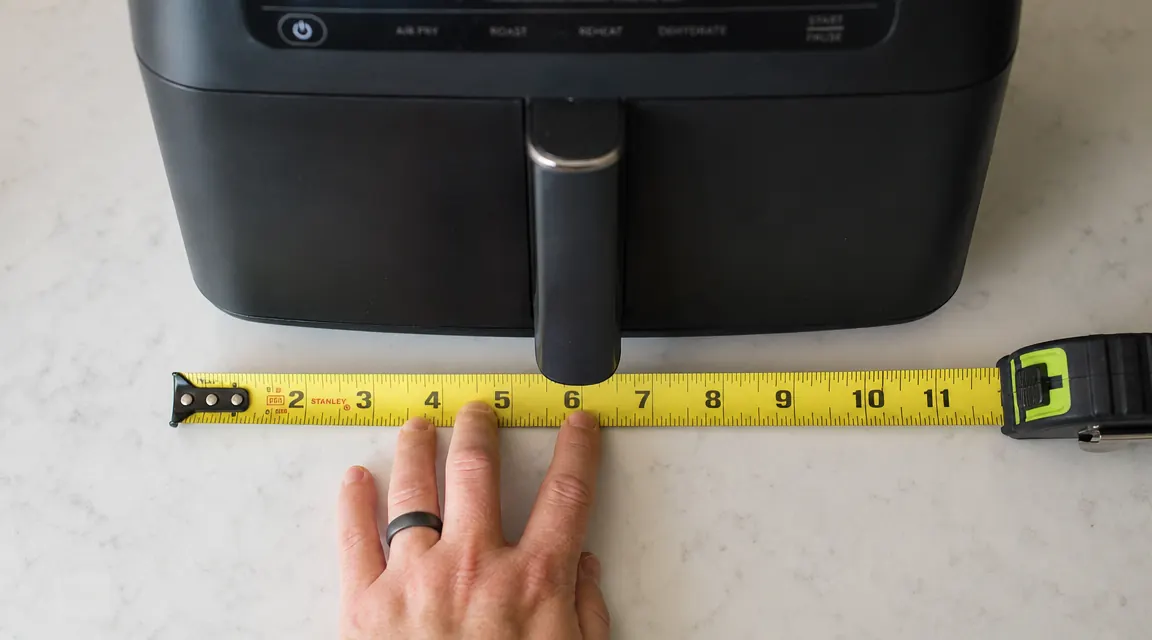
Cooking Performance Head-to-Head
I ran the same six tests in both machines over three weeks: frozen fries at 400F for 14 minutes, chicken thighs skin-side up at 380F for 22 minutes, reheated pizza at 325F for 6 minutes, salmon fillet at 390F for 10 minutes, roasted broccoli at 375F for 12 minutes, and a batch of chicken wings at 400F for 25 minutes. The Ninja won or tied on five of the six tests.
Chicken thighs were the clearest margin. The Ninja's crisper plate produced noticeably better skin crispness. The Cosori thighs were cooked through and tasted fine, but the skin had less texture, sitting slightly soft where it contacted the basket. Frozen fries were nearly identical between the two units, which makes sense since both run close to the same wattage. The one Cosori win was reheated pizza. Its larger square basket let a full slice lay flat without folding the crust, while the Ninja's basket required angling the slice slightly, which affected even heating on the tip. That's a real-world difference for apartment cooks who live on leftover pizza.
The Ninja's footprint is 105 square inches. The Cosori's is 139. In a kitchen with 30 inches of usable counter, that 34-square-inch gap is the difference between fitting a cutting board next to your fryer or stacking things on top of each other.
Long-Term Ownership Considerations
With over 90,000 Amazon reviews and a 4.7 rating, the Ninja AF101 has a longer track record than nearly any comparable compact air fryer. That review volume matters when you're evaluating durability claims. High-volume products surface failure modes quickly when they exist. The Ninja's heating element and basket coating have held up across thousands of long-term user reports. The most common complaint over time is the crisper plate coating showing wear after 18 to 24 months of daily use, which is consistent with any nonstick surface under that kind of heat and frequency.
The Cosori has a strong review base as well, and its build quality is competitive. The primary long-term concern reported in Cosori reviews is button sensitivity on the touch panel after extended use, a known issue with capacitive touchscreens on lower-cost appliances. The Ninja's physical dial interface doesn't have this failure mode. A dial either works or it doesn't, and it tends to last longer than a capacitive panel under repetitive contact. If you're planning to use this appliance daily for two-plus years, the Ninja's physical controls are a reliability advantage.
Who Should Buy Which
Buy the Ninja AF101 if your kitchen has under 18 inches of usable counter width, if you cook skin-on proteins regularly, if you run the appliance daily and want physical controls that won't degrade, or if you're also interested in dehydrating at low temperatures. That covers the majority of small-kitchen cooks in apartments and condos. The Ninja earns its counter space across more use cases and holds up better over time.
Buy the Cosori instead if you have a slightly more generous counter situation, if preset cooking modes genuinely match how you cook, if you cook a lot of frozen convenience foods where presets matter, or if the touchscreen display is important to you for daily usability. The Cosori is a good machine. It just asks for more square inches than the Ninja and delivers comparable cooking results in most scenarios, which is a hard trade for a renter measuring every countertop inch. Read more about long-term Ninja AF101 performance in my full 8-month review, or check out what nobody tells you before buying for a more critical look at the real drawbacks.
The Ninja AF101 takes up less room, cooks skin-on proteins better, and has 90,000 reviews backing its durability.
Check today's price on Amazon and see if it's currently in stock. Prices on the AF101 fluctuate, so it's worth checking now.
Amazon Check Today's Price on Amazon →