
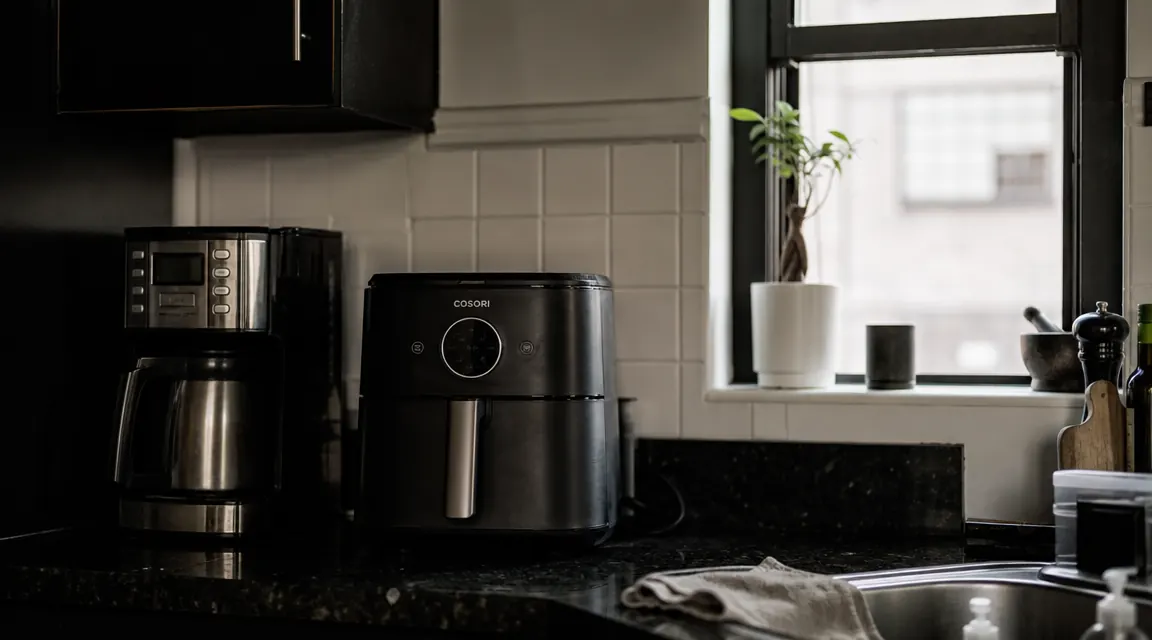
Eight months ago I measured the gap between my toaster and the cabinet corner before I ordered anything. The gap was 12 inches wide. That is the entire decision: if an appliance does not fit in 12 inches, it does not get a spot on my counter in this 400-square-foot Brooklyn apartment. The Ninja AF101 is 11.1 inches wide and 11.4 inches deep. It fit. Barely. And it has been running four to six nights a week ever since.
I want to give you the version of this review that I could not find when I was deciding: what daily use actually looks like after the novelty wears off, which parts of the marketing held up and which did not, and whether a 4-quart capacity is genuinely enough for a single person or a couple cooking real weeknight meals. The Ninja AF101 has a 4.7-star rating across more than 90,000 reviews, and I understand why. I also have some notes on what those reviewers are not telling you.
The Quick Verdict
A compact, reliable air fryer that earns permanent counter space in small kitchens, with one real learning curve on capacity and one quirk on noise you should know before you buy.
Amazon Check Today's Price →If your oven takes 15 minutes to preheat for a 20-minute meal, the AF101 has already solved your problem.
The Ninja AF101 preheats in under 3 minutes and fits in 11 inches of counter width. Check today's price on Amazon before the next price move.
Amazon Check Today's Price on Amazon →How I Have Used It: The Real Eight-Month Picture
I cook four to six nights a week. My kitchen has one small counter run of about 32 inches total, a two-burner electric cooktop, a college-dorm-size fridge, and one outlet near the back wall. I cook mostly for myself, occasionally for two. Protein plus a vegetable four nights a week, batch cooking on Sunday, reheating leftovers on three to four other nights. That is the context for everything that follows.
The Ninja AF101 sits in the left corner of my counter permanently. It has not gone into a cabinet. I tried storing it in the cabinet for the first two weeks and I stopped using it entirely, because getting it out every time added enough friction that I defaulted to my stovetop instead. Counter real estate is a decision, not an accident: the AF101 earns its 11-by-11 footprint by being the appliance I reach for more than any other.
What I cook in it most often: chicken thighs and drumsticks, salmon fillets, roasted broccoli and cauliflower, frozen french fries and tater tots, reheated pizza, crispy chickpeas, and occasional weekend breakfast potatoes. I have also used it for dehydrating apple slices and making jerky at 135 degrees, though I only did that a handful of times. The four functions are Air Crisp, Roast, Reheat, and Dehydrate. I use Air Crisp about 80 percent of the time.
Footprint Reality Check: Counter Inches and Clearance
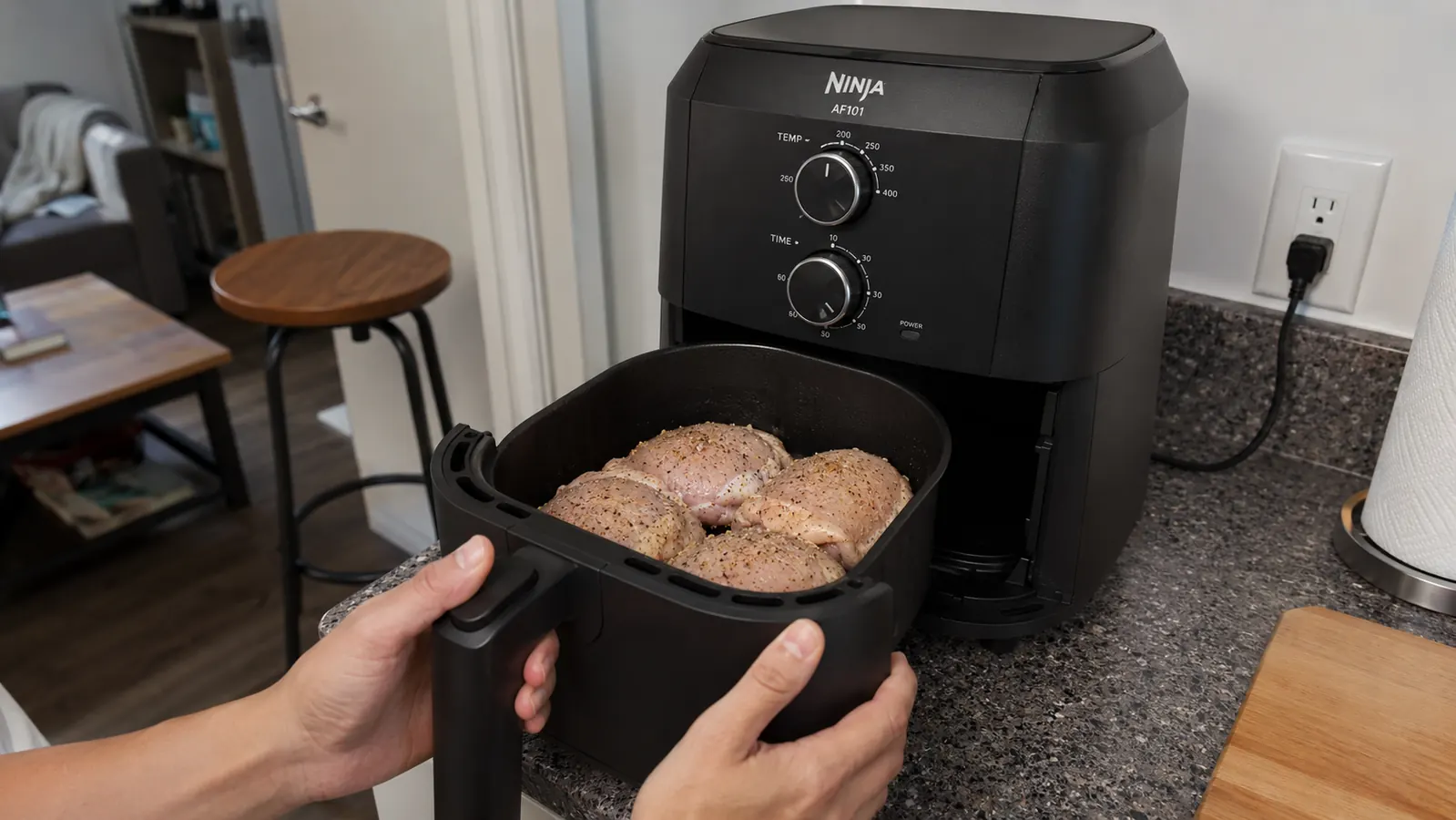
The Ninja AF101 measures 11.1 inches wide, 11.4 inches deep, and 12.2 inches tall. Those are the numbers Ninja lists. What they do not tell you is that you need at least 6 inches of clear space above and behind the unit for the air vents to exhaust properly. My upper cabinet sits 14 inches above my counter. That is just enough, but barely. If your upper cabinet is 12 inches or less above the counter, the heat will hit the cabinet bottom and you will get some discoloration over time. I learned this from a neighbor two floors up who had the same unit.
The cord comes out of the back right corner and is 33 inches long. In my setup, the nearest outlet is about 28 inches from where the unit sits, so the cord reaches without being pulled tight, but it does run along the back edge of the counter. If your outlet is on the opposite wall from where you want to place the unit, plan for an extension cord or rethink the placement. The unit gets warm on the sides during a long cook but not dangerously so. I have had a silicone oven mitt touching the side during a 30-minute cook with no issue.
Cooking Performance Over Eight Months
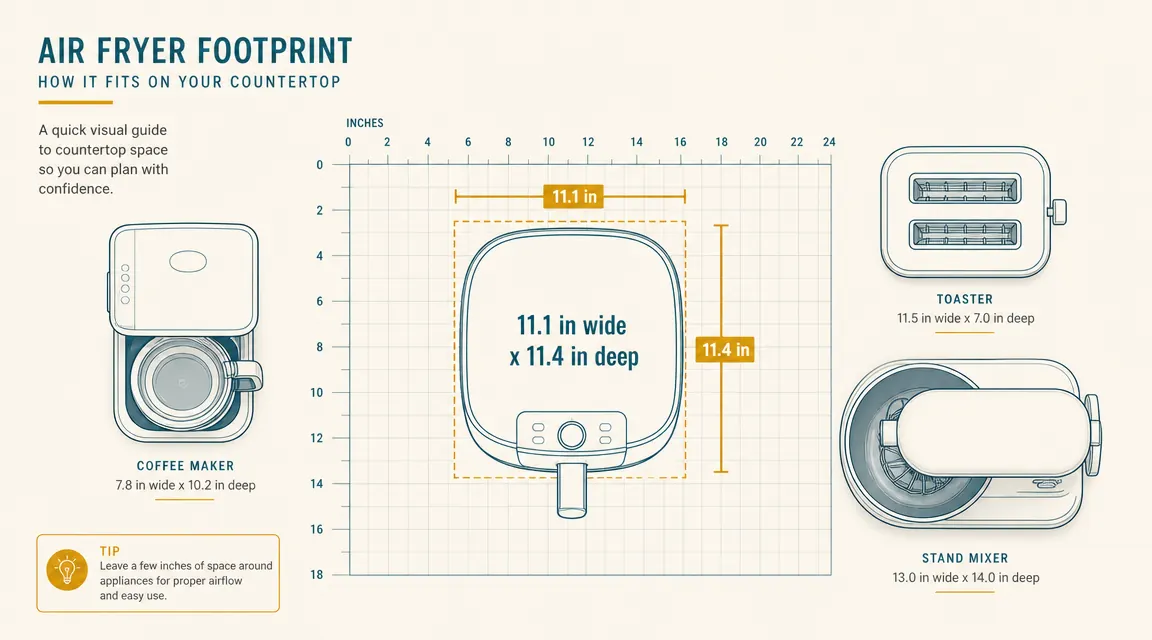
Chicken thighs at 375 degrees for 18 to 22 minutes come out with genuinely crispy skin and juicy interior. This was the thing that sold me on air frying as a real cooking method rather than a reheating convenience: you cannot get that same texture from a stovetop or from a conventional oven without a much longer cook time. My oven takes 12 to 15 minutes to preheat. The AF101 is at temperature in under 3 minutes. That matters on a Tuesday night.
Vegetables roast well. Broccoli, cauliflower, and Brussels sprouts at 390 degrees for 12 to 15 minutes come out with the caramelized edges I would expect from a sheet pan in an oven, without heating up the whole apartment. This matters more than I expected in summer. My apartment has one window AC unit. Running a full oven on an 85-degree July night is a genuine quality-of-life problem. The air fryer runs hot inside its shell and vents warm air, but it does not heat the room the way a conventional oven does.
Reheating is where the AF101 is almost unfairly good compared to a microwave. Leftover pizza at 350 degrees for 3 to 4 minutes comes back with a crispy crust and melted cheese, not a soft, chewy situation. Reheated fries at 375 degrees for 5 minutes are genuinely crispy again. Once you reheat french fries in an air fryer, you will not do it any other way.
Once you reheat french fries in an air fryer, you will understand why the unit earns its counter space even if you only cook twice a week.
Capacity: The Honest 4-Quart Conversation
Four quarts sounds generous. In practice, the usable cooking space is a 9-inch-diameter round basket with about 3 inches of depth. You can fit two chicken thighs comfortably. Three if they are small. A single salmon fillet with room for a handful of green beans alongside. Two pork chops. One small rack of ribs cut in half. That is the real inventory.
If you are cooking for two and want a main plus a vegetable in a single round, you will need to do two batches most nights. A protein in the first round, then pull it out, tent it in foil, and run the vegetables for a second 12-minute cycle. That is the workflow I settled into by month two. It is not a dealbreaker, but it is not the one-and-done experience that single-serve cooking would be. For a household of three or four people, I would look at the 5.5-quart models instead. For one person who occasionally cooks for two, the AF101 is sized right.
One thing the capacity discussion usually misses: you cannot crowd the basket. Air frying works by circulating hot air around the food, and if you overlap pieces or stack them, you get uneven cooking. The practical usable capacity is probably 70 percent of the listed 4 quarts. Factor that into your math before buying.

Noise: What to Expect in an Apartment
The AF101 is not silent. I measured it casually with my phone at about 55 to 58 decibels at arm's length, which is roughly the volume of a running dishwasher or a range hood on medium. You can hold a conversation in the same room. You can watch TV without turning up the volume. You will hear it in a small studio where the kitchen is one corner of the living space, but it is not disruptive.
What does bother me is the fan rundown at the end of a cook cycle. When the cycle ends, the fan keeps running for about 60 to 90 seconds to cool the heating element. The pitch is slightly higher than the cooking noise. It is not loud, but it is the one moment where the appliance sounds like it is doing something unusual. First time I heard it I thought something was wrong. It is normal. Ninja does not mention it in the manual prominently.
Cleaning After Eight Months of Daily Use
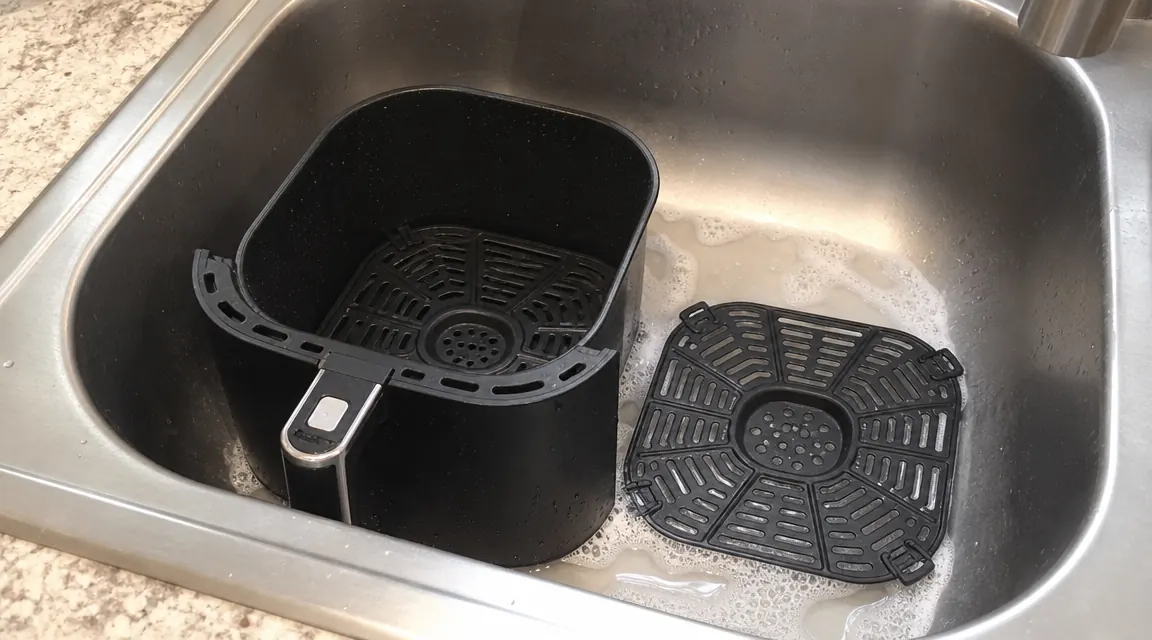
The basket and crisper plate are dishwasher-safe. I hand-wash mine because my apartment kitchen does not have a dishwasher. It takes about two minutes: a rinse, a scrub with a soft brush, and another rinse. The nonstick coating on the basket has held up after roughly 500 cook cycles. I do not use metal utensils in it, which is probably why. The crisper plate has some minor discoloration from cooking at high heat, but it has not affected performance.
The main unit exterior is a matte black finish that shows fingerprints. The control panel is a simple dial with five temperature settings and a timer dial next to it. Nothing digital to fail or cloud-sync or require a firmware update. I appreciate that. The vent on the back accumulates some grease mist over time. A wipe with a damp cloth every couple of weeks keeps it from building up into something harder to clean.
What I Liked
- Compact 11.1-inch footprint fits in tight counter runs common to apartment kitchens
- Preheats in under 3 minutes versus 12 to 15 minutes for a conventional oven
- Chicken skin, roasted vegetables, and reheated leftovers come out genuinely crispy
- Simple dial controls with no app, no Wi-Fi, no firmware updates required
- Basket and crisper plate clean in about two minutes by hand
- Does not significantly heat the room, useful in warm-weather apartment cooking
Where It Falls Short
- Usable cooking space closer to 70 percent of stated 4-quart capacity due to crowding rules
- Cooking for two usually requires two sequential batches for a complete meal
- 60 to 90 second fan cooldown at end of cycle sounds unusual until you know it is normal
- Cord exits from back right corner and may not reach some outlet placements without extension
- Upper cabinet must be at least 6 inches above the unit for proper vent clearance
Who This Is For
If you cook four or more nights a week and your biggest frustration is the gap between wanting a hot meal and having one, the Ninja AF101 closes that gap better than any other single appliance at this size and price. The ideal buyer is a single person or couple in an apartment or condo with a tight counter, a conventional oven they use reluctantly, and a strong preference for not running that oven for a 6-ounce piece of salmon. The AF101 is also the right call if you want a way to revive leftovers without a microwave that makes everything soft. If those sentences describe you, this appliance will earn its footprint every week. For more on how this compares to the competition at this size, see my Ninja AF101 vs Cosori comparison.
Who Should Skip It
If you regularly cook for three or more people and want to plate everyone at the same time, the 4-quart capacity will frustrate you. Go to a 5.5-quart or larger unit and accept a slightly bigger counter footprint. If your counter has less than 11.5 inches of clear horizontal space, or less than 6 inches of vertical clearance to the cabinet above, you have a placement problem that will affect performance and potentially the cabinet finish. If you are primarily looking for something to bake breads, cakes, or casseroles, a compact toaster oven is a better tool. The AF101 is exceptional at air-frying and roasting, but its basket shape is not suited for baking. And if you are the kind of person who buys an appliance, uses it twice, and stores it in the back of a cabinet, skip it. The value per dollar is entirely in the frequency of use. If you are curious whether a compact air fryer makes more sense than your full-size oven for weeknight cooking in general, I also put together a rundown of 10 reasons a compact air fryer beats a full-size oven in a small kitchen.
Eight months in, the Ninja AF101 is the appliance I reach for most nights. Here is where to check today's price.
The AF101 is compact at 11.1 inches wide, rated 4.7 stars by over 90,000 buyers, and covers Air Crisp, Roast, Reheat, and Dehydrate. If you cook most weeknights in a small kitchen, this one earns its counter space.
Amazon Check Today's Price on Amazon →