
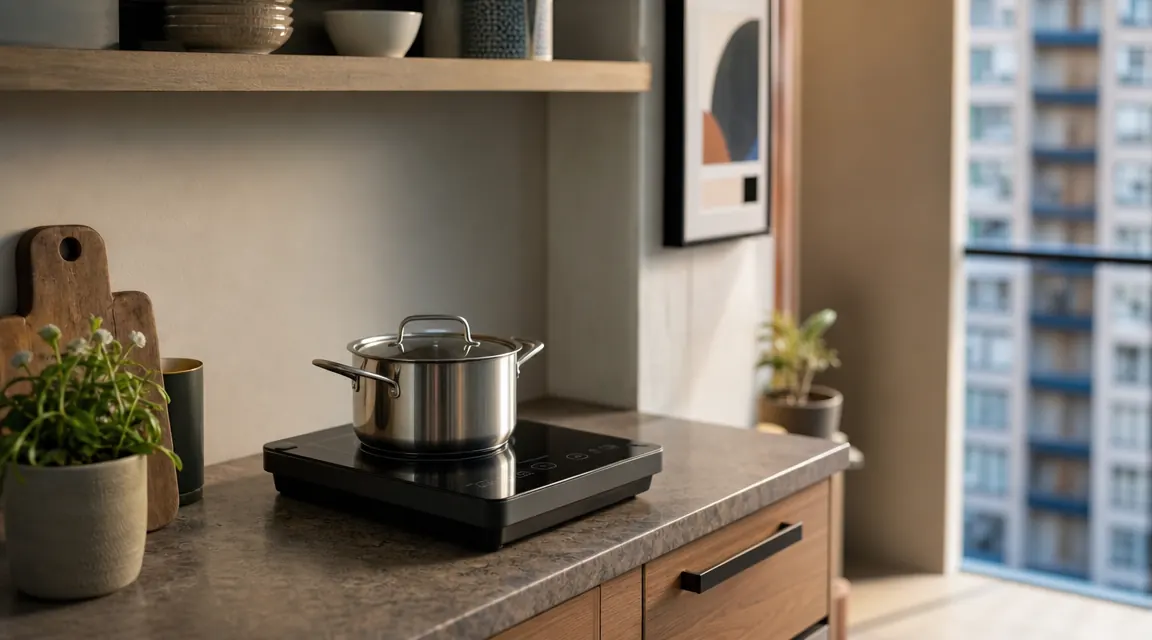
If your apartment has no gas and you are working with a two-foot section of counter between the sink and the microwave, the choice between a Duxtop 9100MC and a NuWave PIC portable induction cooktop matters more than the spec sheet suggests. Both will boil water faster than most built-in coil burners. Both are induction, so your counter stays cool and the heat shuts off automatically when you pull the pan. But the day-to-day experience cooking pasta, searing chicken thighs, or holding a sauce at a low simmer on these two units is genuinely different.
Short answer: the Duxtop 9100MC wins this comparison for most apartment cooks. It delivers more usable power levels across a wider wattage range, it weighs less, and it costs less. The NuWave PIC offers degree-by-degree temperature targeting that a small percentage of cooks will actually use, but that precision comes at a price premium and a heavier unit that takes up more storage space when you are not cooking. If you want to see exactly where each one wins and loses, keep reading.
| Duxtop 1800W | NuWave Portable Induction Cooktop | |
|---|---|---|
| Wattage | 1800W (10 levels, 200-1800W) | 1500W (6 levels, 600-1500W) |
| Footprint | 11.4" x 14.2" | 12.5" x 13.5" |
| Weight | 5.67 lbs | 8.0 lbs |
| Temperature targeting | Power levels only | Degree-by-degree (100-575F) |
| Timer | Yes, up to 170 min | Yes, up to 99 min |
| Safety shutoff | Yes, with pot-detection | Yes, with pot-detection |
| Noise at low settings | Quiet below level 5 | Fan audible at most settings |
| Current price | Mid-range | Check today's price on Amazon |
Where the Duxtop 9100MC Wins
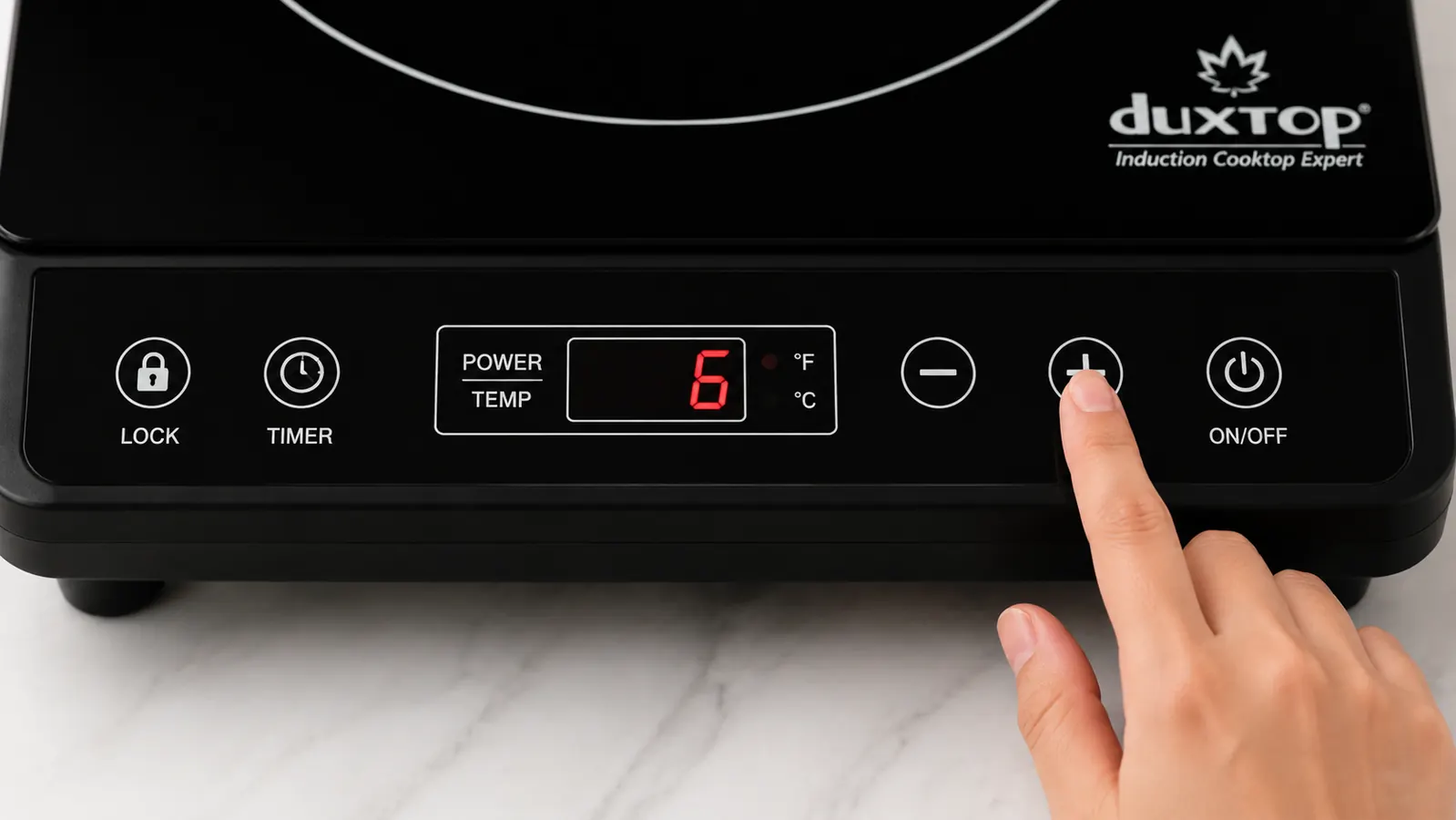
The Duxtop's 1800 watts across 10 power steps gives you a cooking range that covers practically every weeknight task. At level 10, a pot of 4 cups of water reaches a rolling boil in roughly 4.5 minutes. At level 2 or 3, you can hold a beurre blanc or a chocolate melt without the erratic cycling that shows up on cheaper single-burners. That spread matters when you are cooking real meals rather than just reheating. The NuWave tops out at 1500 watts, which is adequate for most things, but you will notice the extra ceiling when you are trying to get a fast sear on a cold skillet.
Weight and storage are practical wins you feel every time you pull the unit out. At 5.67 lbs, the Duxtop slides in and out of a lower cabinet without any awkwardness. The NuWave at 8 lbs does not sound dramatically heavier on paper, but when your cabinet is already stacked with a cutting board and a cast iron skillet, the extra 2.3 lbs is real. The Duxtop is also slightly more compact at 11.4 inches wide, which matters if your counter gap is measured tightly. I set mine between a dish rack and the backsplash, and the fit was comfortable with about an inch on either side.
At level 2, the Duxtop held my butter sauce at a near-simmer for 20 minutes without breaking. That is more low-end control than I expected from a budget single-burner.
Where the NuWave Wins
The NuWave's degree-by-degree temperature targeting is a real differentiator if your cooking actually calls for it. You set 275 degrees for tempering chocolate, 375 for a shallow fry, 212 for a low simmer, and the unit targets those temperatures directly rather than asking you to learn what power level 4 corresponds to in your specific pan. If you do a lot of candy work, deep frying, or sous-vide-adjacent temperature holding, that precision is genuinely useful. For a cook who needs to hold oil at 350 degrees for frying doughnuts or hush puppies on a consistent weekend basis, the NuWave is the more capable tool.
The NuWave also ships with a few accessories in some bundles, including an extender ring that lets you use pans with a base wider than the standard induction coil. If you cook primarily in a 12-inch carbon steel pan, that ring prevents the efficiency loss you would otherwise see at the edges. The Duxtop does not include that accessory, though the 9100MC's wider coil element handles most standard cookware sizes without issue.
You are cooking without gas in a 400-square-foot kitchen. Here is the burner that handles it.
The Duxtop 9100MC 1800W is the portable induction cooktop most apartment cooks should buy. More power levels, lighter weight, a smaller footprint, and considerably less expensive than the NuWave. Check today's price on Amazon before deciding.
Amazon Check Today's Price on Amazon →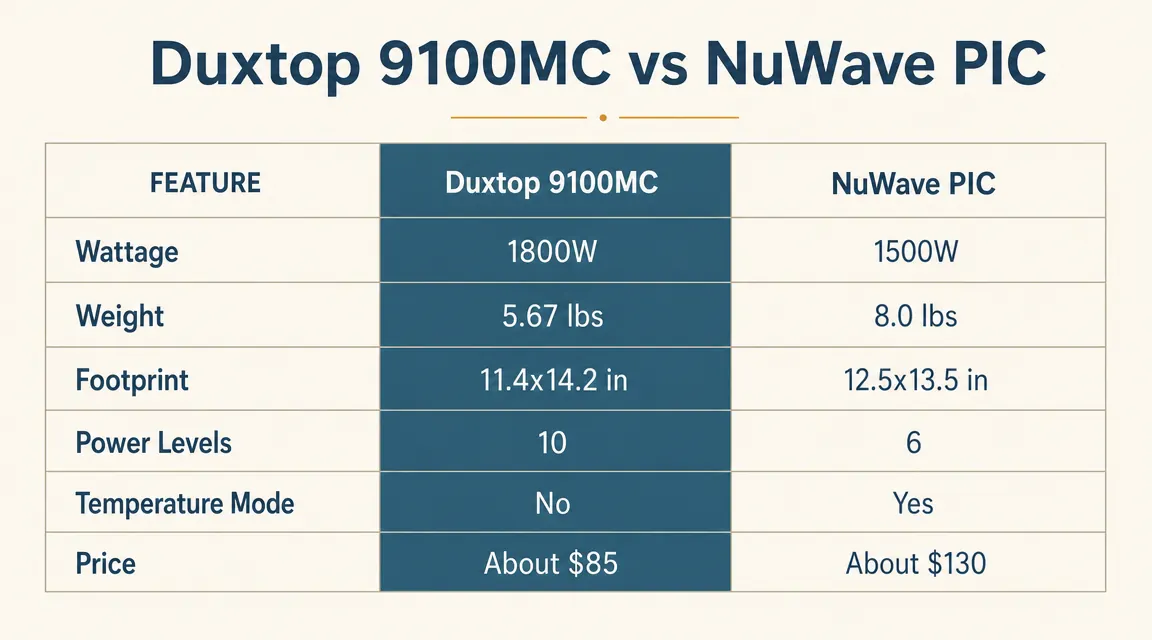
Power Level Control vs Temperature Targeting: What Actually Matters
The core philosophical difference between these two cooktops is how they let you control heat. The Duxtop uses power levels, numbered 1 through 10, each corresponding to a wattage increment. You learn what your pans do at each level after a few sessions. Level 5 on a 3-quart stainless saucier with a flat base holds a steady simmer. Level 8 in a 10-inch cast iron skillet gets you a solid sear. It takes about a week to internalize, but once you do, the control feels natural because you are responding to the pan and the food directly.
The NuWave asks you to trust the unit's thermometer over your own pan observation. In theory that is more precise. In practice, induction cooktops measure surface temperature indirectly through the coil field, and the reading is affected by pan material, pan thickness, what is in the pan, and how full it is. The degree-by-degree display implies a precision that the physics of the system does not always deliver. For everyday cooking, the power-level approach of the Duxtop is actually more reliable than it sounds, and less likely to produce false confidence in a specific temperature reading.
Cookware Compatibility in a Small Kitchen
Both cooktops require induction-compatible cookware, meaning cast iron, most stainless steel, and enameled steel will work. Aluminum, copper, and non-magnetic stainless will not unless the manufacturer has specifically built in a magnetic base. This is not a differentiator between these two models; it is a feature of induction cooking generally. If you are setting up a new kitchen and going induction from scratch, budget for at least one induction-compatible saucepan and skillet. A basic two-piece cast iron set handles 90 percent of what either of these units can do.
One practical note specific to the Duxtop: it will detect a minimum pan size. Pans smaller than about 4.7 inches in diameter will not trigger the coil. That rules out espresso stovetop moka pots and very small sauce pans on this unit. The NuWave has a similar minimum size requirement. If you regularly use very small pans, both models have this limitation, but it is worth knowing before you buy.

Noise, Heat, and Apartment-Friendliness
Induction cooktops use a cooling fan, and both of these units run that fan whenever the coil is active. The Duxtop is notably quieter at lower power levels because the fan speed scales with the output wattage. At levels 1 through 5, the fan is a soft background hum. At level 9 or 10, it becomes audible but not disruptive. The NuWave's fan runs at a higher baseline speed across most settings, which some users find distracting in a quiet apartment. Not a dealbreaker, but worth noting if you live with a light sleeper or work in a studio where the kitchen is three feet from your desk.
Both units stay cool on top when the pan is not present, and both have automatic shutoff when a pan is removed or when the timer expires. The Duxtop shuts off within a few seconds of pan removal. Neither unit heats the surrounding counter, which is a genuine advantage over coil or gas in a small space where you do not have room to let a hot surface cool before using the counter for something else.
Who Should Buy Which
Buy the Duxtop 9100MC if you cook real weeknight meals in a small apartment and need a reliable burner that handles everything from a fast boil to a low simmer, fits in a tight cabinet, and is affordably priced. This covers the vast majority of apartment cooks. If you have used a gas burner for years and you want the closest equivalent experience in an induction unit, the power-level control of the Duxtop will feel familiar faster than the NuWave's temperature system. It is also the right call if you are equipping a rental for the first time and do not want to spend more than you need to on a single burner.
Buy the NuWave if you regularly do tasks that genuinely benefit from degree-specific temperature control: candy work, deep frying with a consistent oil temperature, holding bone broth at exactly 180 degrees, or tempering chocolate. You are paying a real premium for that feature, and it is only worth that premium if you use it consistently. If you are buying it just because a precise temperature readout sounds more professional than a numbered power dial, save the money and put it toward better cookware.
For the long-term review of the Duxtop in a real no-gas apartment kitchen, read the Duxtop 1800W long-term review. For a more candid look at its drawbacks and who should skip it, the Duxtop honest review covers the parts most product pages leave out.
The 1800W Duxtop handles a full apartment cooking setup at a mid-range price point. Check whether that price has moved.
Most small-kitchen cooks do not need degree-by-degree temperature targeting. They need a burner that boils fast, simmers steady, fits in a cabinet, and does not cost more than the cookware. The Duxtop 9100MC is that burner.
Amazon Check Today's Price on Amazon →