
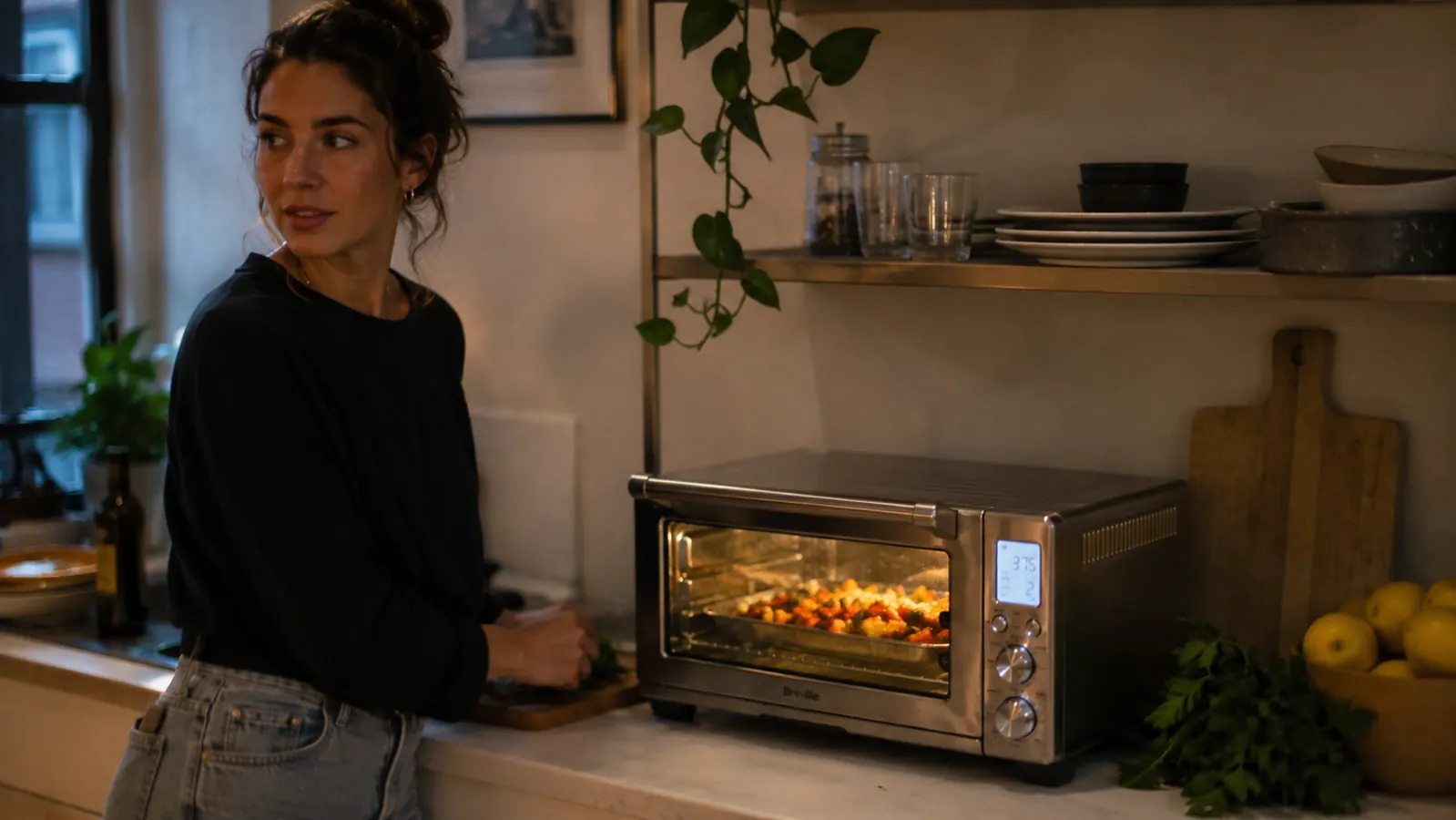
My kitchen in my Dallas one-bedroom measures 7 feet wide. The full-size oven that came with the apartment preheat takes 18 minutes and heats the whole room from May through October. I stopped using it in summer entirely, which meant no roasted vegetables, no baked chicken, no anything that needed steady dry heat. That changed when I put a Breville BOV450XL Mini Smart Oven on the short stretch of counter between my sink and my refrigerator. It sits in a 16-inch-wide footprint and, after about two weeks of figuring out what adjustments to make, it now handles probably 80 percent of what I used to do in the full-size oven.
The learning curve is real, though. A compact countertop oven is not a miniaturized full oven. The heating elements are closer to the food. Convection fans in most models run at different speeds than in a wall oven. The temperature swings differently. If you treat it exactly like a full-size oven, you will burn the tops of things while the bottoms stay underdone, or you will overbake delicate items by 10 minutes because the temperature setting on the dial does not match the actual interior temperature. This guide is the system I worked out, step by step, for getting reliable results.
Stop fighting your full-size oven in a kitchen that wasn't built for it.
The Breville BOV450XL Mini Smart Oven fits in a 16-inch footprint, preheats in under 5 minutes, and handles everything from toast to roasted chicken. It is the compact oven that earns its counter space.
Amazon Check Today's Price on Amazon →Step 1: Understand Your Oven's True Temperature
Before you cook a single thing, spend five dollars on an oven thermometer and put it on the center rack. Set your compact oven to 375 degrees Fahrenheit and let it run for 15 minutes. Then read the thermometer. Most compact toaster ovens run 15 to 25 degrees hotter than the dial setting, especially near the top heating element. The Breville BOV450XL is better calibrated than most, but I still found mine ran about 12 degrees hot in convection mode. Note the actual number. That is your offset, and you will use it every single time.
The other thing to map is your hot spots. With an oven thermometer, check the left side, right side, front, and back. In most compact ovens the rear runs hotter because the convection fan pushes heated air from the back forward. In a full-size oven this even out because the cavity is large. In a countertop oven the physics are compressed. Rotate pans halfway through cooking until you learn where your oven runs hot, then adjust placement accordingly.
The Breville's IQ Element technology helps a lot here. It uses four independent heating elements rather than top and bottom only, which reduces the dramatic top-burn problem common in smaller units. Still, knowing your offset takes guesswork completely out of the process.
Step 2: Get the Right Pan Sizes Before You Cook Anything Else
The number one mistake small-oven cooks make is using pans that are too large. The BOV450XL interior is designed for a quarter-sheet pan, which measures 9 by 13 inches. If you force a half-sheet pan in, it blocks airflow around the edges and creates uneven browning. Worse, the pan sides sit so close to the heating elements that the edges of your food get scorched while the center lags behind.
Buy a quarter-sheet pan with a small wire rack that fits inside it. This combination lets you roast chicken thighs or fish with air circulating underneath, which is how you get crispy skin in a countertop oven. A 6-inch round cake pan and a 9-by-5-inch loaf pan also fit the Breville interior. Write these dimensions on a sticky note inside a cabinet door. When a recipe calls for a 9-by-13 baking dish, you already know you need to scale down or cook in two batches.
Dark metal pans absorb heat faster and cook 10 to 15 percent faster in a compact oven than they do in a full oven. If you inherited a dark nonstick sheet pan, drop your temperature by 25 degrees or check your food 8 minutes early. Light aluminum or stainless pans give you more headroom for error.
Step 3: Adjust Temperature and Timing for Each Food Type
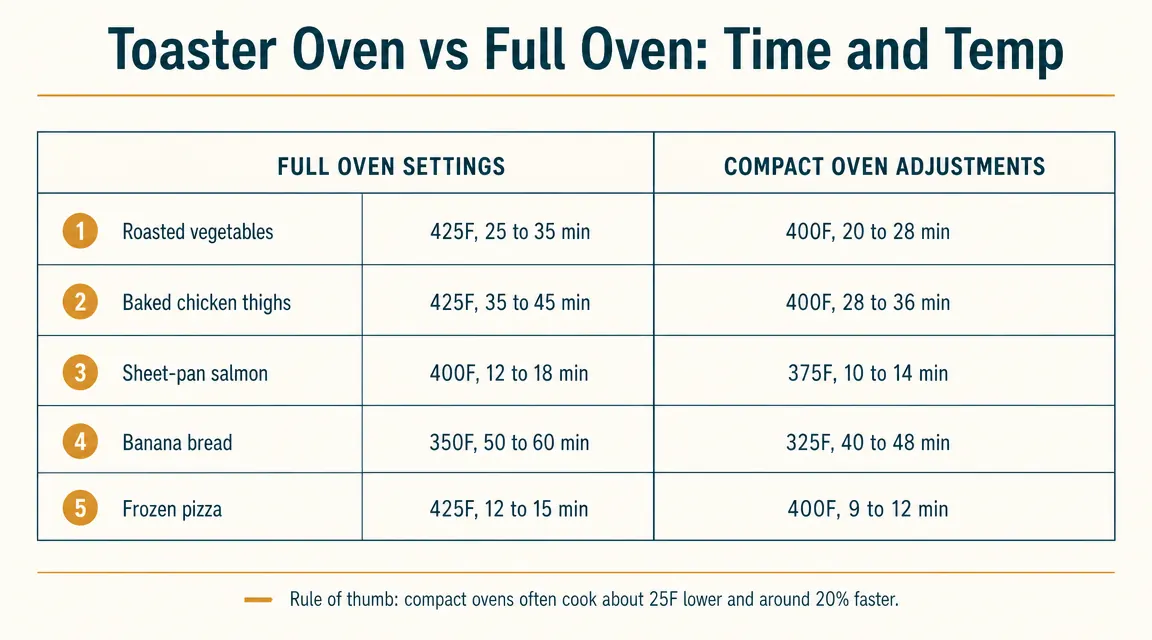
The general rule is to reduce your recipe temperature by 25 degrees Fahrenheit when converting from a full-size oven to a compact convection oven. If the recipe does not already call for convection, reduce time by about 20 percent too. That combination usually lands you in the right zone.
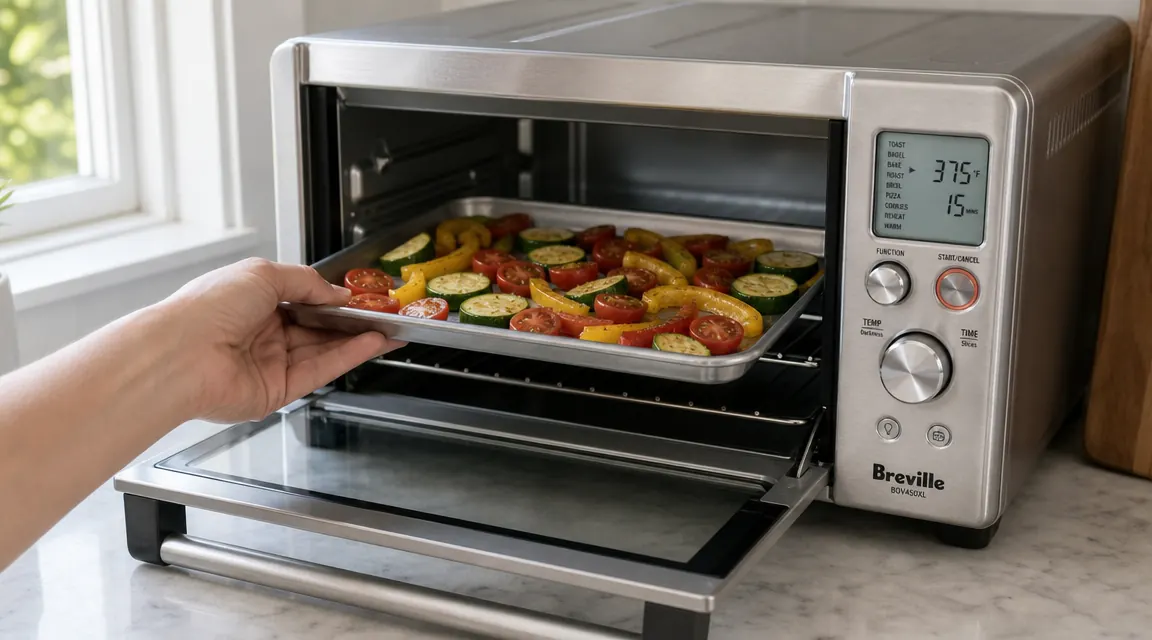
For roasted vegetables, I run the Breville at 400 degrees on the Bake setting with convection on. Single-layer cut vegetables like zucchini coins, broccoli florets, or halved cherry tomatoes take 16 to 20 minutes, with one flip at the midpoint. The key is single layer. In a compact oven you cannot stack or crowd the pan. The moisture that crowded vegetables release has nowhere to go in the smaller cavity and you end up steaming instead of roasting. Cut less, cook in batches if you need volume.
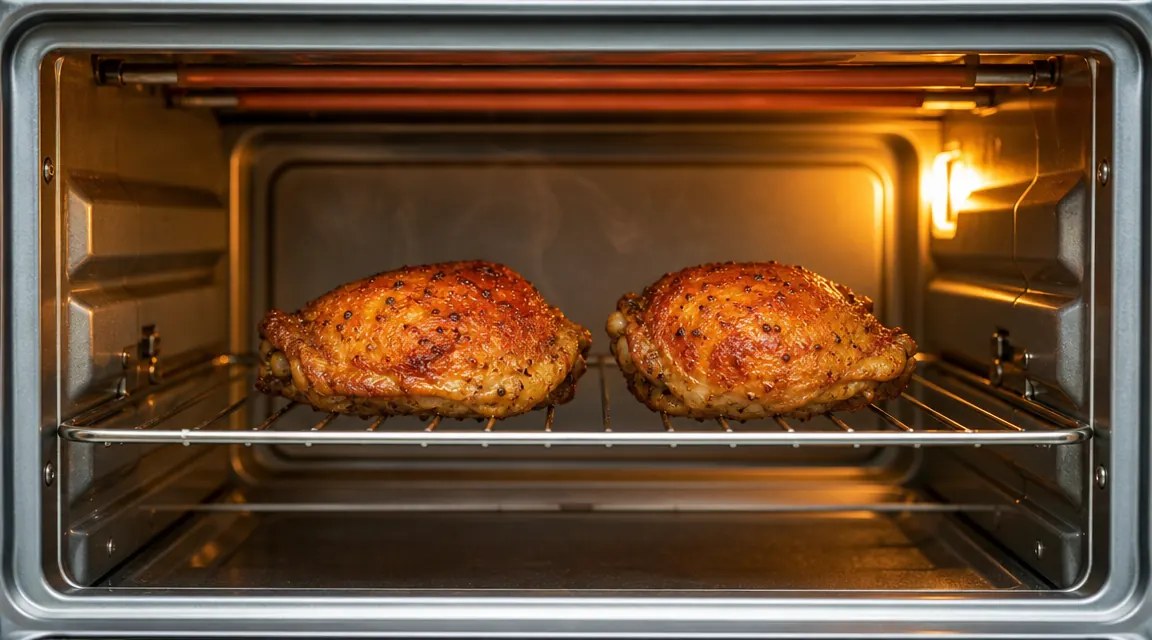
For proteins, chicken thighs are the most forgiving. Bone-in, skin-on thighs at 425 degrees on the Roast setting for 35 to 38 minutes, placed on a wire rack over a quarter-sheet pan, come out with crackled skin and juiced-through meat. Salmon fillets at 400 degrees for 12 minutes. Pork tenderloin at 400 for 22 minutes, resting 5 minutes after. These numbers are for the BOV450XL after accounting for my 12-degree calibration offset. Your offset may differ, so treat the first cook of any new protein as a calibration run.
Step 4: Use the Correct Function, Not Just the Temperature Dial
The Breville BOV450XL has four preset functions: Toast, Bake, Broil, and Roast. These are not marketing labels. They change which elements fire and in what sequence, and they matter more than the temperature setting in some cases.
Roast fires the top element at high intensity initially to sear the outside, then transitions to a more even all-element bake to cook the interior. If you roast chicken on the Bake setting instead, you get fully cooked chicken but no browning on the skin. The opposite problem happens with baked goods: use the Roast setting for a banana bread and the top will crack and darken before the interior is set. Bake uses more balanced heat and is what you want for anything with leavening.
Broil is your finish tool. Use it for the last 2 to 3 minutes of a gratin, casserole, or anything that needs a bubbly browned top. At close proximity to the top element in a compact oven, Broil can go from golden to charred in 90 seconds. Set a timer and watch through the glass door.
In my 7-foot-wide Dallas kitchen, 80 percent of what I used to do in the full-size oven now happens in a 16-inch footprint. The learning curve took two weeks. The counter space reclaimed is permanent.
Step 5: Plan Your Meals Around the Quarter-Sheet Pan
The most efficient way to cook in a compact toaster oven is to treat the quarter-sheet pan as your building block. Almost every weeknight dinner I make now starts with that pan. The basic formula: a protein on the wire rack, a pile of cut vegetables directly on the pan underneath, seasoning, a drizzle of oil, and the Roast function. The protein drippings fall onto the vegetables and add flavor. Everything comes out at roughly the same time if you pick proteins and vegetables with similar cook times.
A few combinations that work reliably in the BOV450XL: chicken thighs over cherry tomatoes and asparagus spears at 425 for 35 minutes; salmon fillet over zucchini and red onion at 400 for 15 minutes; Italian sausage links over sliced bell peppers and onions at 400 for 25 minutes. Scale quantities to what fits in a single layer on a quarter-sheet pan, which in practice means two thighs, one salmon fillet, or two sausage links at a time. For one or two people this is exactly the right yield.
For baking, the same pan logic applies. Brownies in a 9-inch square pan that has been cut down to fit, or one loaf of banana bread, or eight muffins in a standard muffin tin that fits the BOV450XL cavity. Batch baking is not practical in this oven for a large household. For one or two people baking in small batches, it is excellent and far less wasteful of energy than running a full oven for a single loaf.
What Else Helps
A probe thermometer eliminates guesswork on protein doneness. The BOV450XL does not have a built-in probe, so an inexpensive instant-read or leave-in probe thermometer fills that gap. Chicken thighs to 165 at the thickest point, pork tenderloin to 145, salmon to 125 for medium. Hitting these numbers matters more in a compact oven where temperature swings can be wider than in a well-insulated full oven.
Silicone baking mats cut cleanup time significantly. The BOV450XL's interior is not huge, and scrubbing baked-on oil residue from a quarter-sheet pan in a small sink is a real inconvenience. A quarter-sheet silicone mat drops right in, prevents sticking, and takes five seconds to wipe down. For anything you want more browning on, skip the mat and use parchment instead, since parchment allows more direct heat transfer than silicone.
Rack position is easy to overlook. The BOV450XL has two rack positions. Center is for most baking and roasting. The lower position, closest to the bottom element, is better for pizza and anything where you want the bottom crust to set before the top browns. The upper position, close to the top element, is where you put things you want toasted or broiled quickly. Moving the rack takes two seconds and meaningfully changes how heat contacts your food.
The Breville BOV450XL is not a toy oven. It is a serious piece of equipment that rewards learning. Once you have the calibration offset, the right pans, and the right function for each task, it stops feeling like a compromise and starts feeling like an upgrade.
If you want a longer look at how the BOV450XL performs over months of regular use rather than a single cook, the two-year review covers durability, element performance, and what wears out first: see the Breville BOV450XL long-term review. And if you are still deciding whether this is the right compact oven for your kitchen or want a no-filter buyer's assessment, the Breville BOV450XL honest review covers who should buy it and who should pass.
The compact oven that actually handles real cooking, not just toast.
The Breville BOV450XL Mini Smart Oven preheats in under 5 minutes, fits a quarter-sheet pan, and has four dedicated functions so you stop guessing which setting to use. If you are cooking real food in a small kitchen, this is the tool that earns its 16-inch footprint.
Amazon Check Today's Price on Amazon →